Part 1: Understanding the Two Types of Solar Support Structures Starting with the Overall Project Layout. Part Two: An In-Depth Look at Foundation Systems and Site Adaptability. Part Three: Analyzing Differences in Core Components and Materials of Support Structures. Part Four: Examining Connection Nodes and Moving Parts of the Support Structure. Part Five: Comprehensive Evaluation from the Big Picture to the Details and Making a Choice
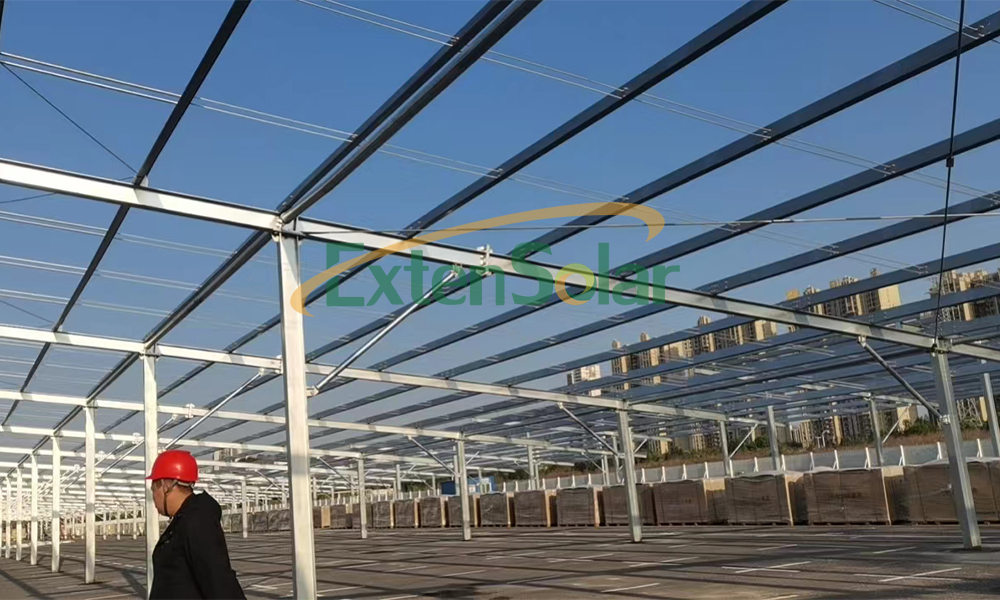
Part 1: Understanding the Two Types of Solar Support Structures Starting with the Overall Project Layout In the design phase of solar power stations, one of the first decisions to be made is which kind of solar support structure to choose. The two most common ones in the market are the fixed solar support structure and the tracking solar support structure.The fixed system that features maintaining a fixed inclination angle after module installation and the tracking system that can automatically adjust the angle to follow the position of the sun.From the overall project layout perspective the array arrangement of the fixed solar support structure is relatively simple and the row spacing is mainly determined according to the principle of no shading on the winter solstice. As for the tracking solar support structure the situation is different because the panel will cast dynamic shadows when tracking it requires a larger floor area its row spacing is usually 30% to 50% wider than that of the fixed system.If your land area is limited, the fixed solar support structure can often enable you to install more capacity panels. On the contrary, if the land is sufficient and the electricity price is also high, the tracking solar support structure can increase the power generation to enhance the project income.When it comes to the project layout, first one has to determine the area and the shape of the land which is the first step in choosing the solar support structure.
Part Two: An In-Depth Look at Foundation Systems and Site Adaptability When gazing at the site under the surface there are significant differences among the foundation configurations of the two types of solar mounting structures fixed solar support structures commonly use individual concrete foundations steel screw piles or strip foundations.Each basic structure bears relatively stable loads, including the self - weights of the modules and brackets as well as the wind and snow loads.The basic spacing can be adjusted flexibly according to the soil conditions. But the tracking solar support structure is entirely different because the tracking system has driving motors, rotating reducers, and controllers, etc., and the center of gravity of the structure will move when the module rotates.This requires that the foundation of the tracking solar support structure needs to have a relatively high anti-overturning ability, usually a larger concrete foundation or a deeper helical pile is needed. Moreover, the foundation designs of the driving side and the non-driving side are also different.On the soft soil foundation, the fixed solar support structure can solve the problem by using extended helical piles while the tracking solar support structure may need backfilling or some form of foundation treatment.On rocky terrain both types of solar support configurations need rebar anchoring or bolt anchoring methods however tracking systems call for higher precision and deeper drilling thus in terms of site adaptability soil conditions and terrain complexity have a direct impact on the solar support structure one selects.
Part Three: Analyzing Differences in Core Components and Materials of Support Structures Focusing on the key parts of solar support structures, there can be evident differences between fixed and tracking systems in terms of material utilization and component arrangement. The parts of fixed solar support structures are quite simple, mainly consisting of columns, braces, main beams, and purlins.These components are generally made of cold - formed or hot - rolled steel profiles and the connections are mainly made through bolt connections with few welded joints being present.Generally speaking, a typical fixed solar support structure per megawatt generally needs about 35 to 45 tons of steel. The tracking solar support structure is much more complicated; besides the load - bearing components, there are also rotating drive mechanisms, transmission connecting rods, shock absorbers and control systems and so on.The main beam needs to have greater torsional rigidity and the columns need to be capable of bearing different bending moments. The single - axis tracking solar support structure generally uses 50 to 70 tons of steel per megawatt, while the double - axis tracking system needs more.From the material side, the fixed solar support structure can make more utilization of zinc-aluminum-magnesium coating materials to reduce costs. As to the tracking system, because it has moving components and there is a risk of galvanic corrosion, the requirements for anti-corrosion and insulation are even stricter.What if your project has a limited budget then the fixed solar support structure has obvious advantages in terms of material cost indeed.
Part Four: Examining Connection Nodes and Moving Parts of the Support Structure On a more microscopic level the design quality of connecting nodes directly determines the long-term reliability of the solar support structure. The connecting joints in the fixed solar installation structure are mainly static connections. Once tightened with bolts there will be no relative movement occurring.As long as the initial installation torque is in line with the standard and anti-loosening washers or nuts are used, these joints that have operated for ten years are still quite stable .Common joint types consist of column base joints, beam - column joints and purlin connection joints. The design principle is to ensure a clear force transmission path and also to avoid the eccentric conditions.Tracking the situation of solar energy support structures is far more complex. Such structures are not only equipped with static connection nodes but also have a great number of movable joints. The connections between the transmission shafts and the main beams, the joints between the push rods and the supports, the cooperation between the bearing blocks and the columns - these movable components all need to be lubricated and maintained on a regular basis.The sealing performance is also extremely important because the dust and moisture entering into the drive system will accelerate the wear and tear.Additionally, the tracking solar support structure has to make use of limit switches and dampers so as to prevent the panels from excessive rotation when there is strong wind. From the perspective of maintenance, the fixed solar support structure has almost no moving parts that need to be replaced at regular intervals, while the drive motors and gearboxes in the tracking system usually have a design life of 10 to 15 years and may need to be replaced once during the project life cycle.This difference determines the scope and the cost of your future operation and maintenance work.
Part Five: Comprehensive Evaluation from the Big Picture to the Details and Making a ChoiceThrough integrating the information of the above four levels, a distinct decision framework can be worked out. Commencing from the overall project arrangement, if you have a large area of flat land and the electricity cost is quite high, the tracking of the solar support structure that can increase the power generation by 15% to 25% makes the additional investment well worth it.However, in case you come across situations of limited land supply, complicated terrain, or tight budgets, the fixed solar support structures will truly become the more reliable and stable choices.From the basic level to the component level and then to the connection level the meaning conveyed at each level is the same although tracking solar support structures can generate more electricity they also put forward higher requirements for on - site conditions construction precision and post - installation maintenance for small - scale projects below 5 megawatts fixed solar support structures are usually more cost - effective solutions.For large - scale ground - mounted power plants, a mixed approach can be adopted to combine two solar support structures: using tracking systems in clearly demarcated unobstructed areas and fixed systems in corner areas or areas close to shadow edges. Eventually, choosing the optimal solar support structure is by no means an easy thing, not an either - or situation but rather a matter of making a comprehensive decision based on one's land resources, budget and operation and maintenance capabilities.We wish this selected guide that includes all aspects from the macro - great situation to the tiny details to be able to help you in making the correct decision.


